Ikigai · Self-Discovery · Purpose · Life Framework · 7 min read
Most people spend years — sometimes decades — searching for purpose. They read books, attend retreats, switch careers, move cities. And still the question lingers: what am I here for? The Japanese philosophy of ikigai suggests the answer has been within reach the whole time. It just requires four honest questions — and the courage to sit with what comes up.
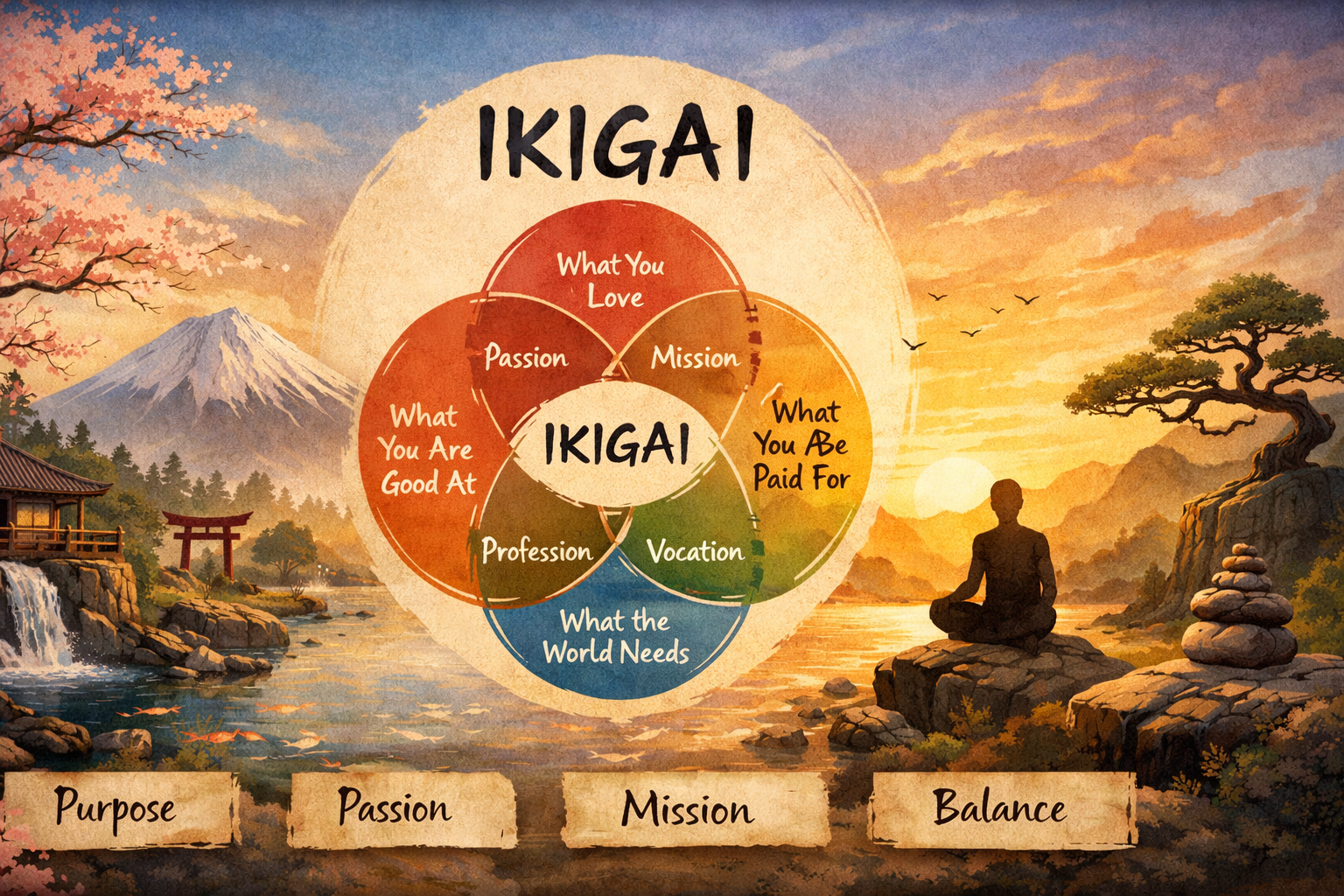
The ikigai framework is elegant in its simplicity. At its core, it asks you to explore four dimensions of yourself and your relationship with the world. Where those four dimensions overlap — that intersection — is your ikigai. Your reason for being.
But here’s what most articles about ikigai miss: the quality of your answers depends entirely on the quality of the questions you ask yourself. Shallow questions produce shallow answers. Vague answers produce vague direction. In this post, we’re going deep on each of the four questions — unpacking what they’re really asking, what honest answers look like, the mistakes people make when answering them, and the prompts that will help you go beneath the surface.
Before You Begin: How to Get the Most From This
These four questions work best when you approach them in a specific way. A few guidelines before we start:
Question 1 of 4
What do you Love?
The passion circle — what makes you feel most alive
What this question is really asking
Not: what do you enjoy in a vague, general sense. The question is after something more specific — the activities, topics, and experiences that light you up from the inside. The things that make time disappear. The subjects you read about for fun. The conversations that energise rather than drain you. The work you’d do even if it were a hobby.
This circle is where most people either go too broad (“I love people”) or dismiss what’s most true (“I love writing but that doesn’t count”). Both are traps. Go specific. Go honest.
Deep-dive prompts — go beyond the obvious:
- What did you love doing as a child, before anyone told you what was practical?
- What topic could you talk about for three hours without noticing the time pass?
- When you scroll past someone online and feel a genuine pang of envy — what are they doing (not having)?
- What do you find yourself doing in your “wasted” time — the hours you don’t account for?
- What activities leave you feeling more energised after doing them than before?
- If money, status, and other people’s opinions were completely irrelevant — what would you spend your time on?
- What would you teach if you had to teach one subject for the rest of your life?
Common mistakes with this question
✗ Too broad
“I love helping people” — this is a value, not a love. Go deeper: helping people do what? In what context? Through what medium?
✓ Specific and honest
“I love helping people understand complex medical situations in plain language” — this is specific enough to act on.
✗ Dismissing the real answer
“I love cooking but that’s just a hobby” — who decided hobbies don’t count? Write it down. Everything counts in this circle.
✓ Taking it seriously
“I love cooking, specifically the chemistry of fermentation and sharing food as an act of care” — now you have something to work with.
The sign you’ve got it right: When you read your answer back and feel a small lift — a quiet recognition that says yes, that’s true. That feeling is your compass.
Question 2 of 4
What are you Good At?
The vocation circle — your real, underestimated strengths
What this question is really asking
Not: what qualifications do you have. Not: what does your CV say. This question is after your genuine abilities — the things you do naturally and well, the skills you’ve developed through obsession or experience, and crucially, the things you undervalue because they feel too easy.
This is the hardest circle for most people — not because they lack strengths, but because they can’t see them objectively. We’re all prone to taking our greatest abilities for granted precisely because they come naturally to us. The antidote is to look outward as well as inward: what do others consistently ask you for? What do people thank you for without being prompted?
Deep-dive prompts — uncover the hidden strengths:
- What do people ask you for help with, repeatedly, without you advertising it?
- What comes so naturally to you that you assume everyone can do it — but they can’t?
- What have you spent 100 hours or more practising or learning, because you wanted to?
- What do your closest friends or colleagues consistently praise you for?
- In past roles, what tasks did you finish faster or better than colleagues without really trying?
- What did your best managers or mentors say you were unusually good at?
- What skills have you built outside of work — through hobbies, parenting, volunteering — that you’ve never put on a CV?
- If a stranger watched your best working day, what specific abilities would they notice?
Think in three layers
Hard Skills
Technical, teachable: coding, writing, analysis, design, languages
Soft Skills
Human abilities: empathy, leadership, listening, teaching, negotiating
Meta Skills
Rare abilities: systems thinking, synthesis, simplifying complexity, pattern recognition
The sign you’ve got it right: When you list a strength and immediately think “but everyone can do that” — stop. That thought is the signal you’ve hit something real. Things that feel obvious to you are often extraordinary to others.
Question 3 of 4
What does the World Need?
The mission circle — where your gifts meet real human need
What this question is really asking
Not: what does the entire planet need at a global, systemic level. That framing is paralyzing, and it’s not what ikigai is asking. The question is more personal and more actionable: where do your specific gifts meet a real, human need that you are positioned to address?
The “world” in this circle can be as large as a global industry or as small as your local community, your team at work, or your family. The size doesn’t matter. The genuineness of the need and your ability to meet it — that’s everything.
Pay close attention to what makes you angry. Sustained frustration with a problem in the world — when you think “why doesn’t someone fix this?” — is often the most precise signal of what you are called to contribute. The problems that bother you most are usually the ones you’re best equipped to solve.
Deep-dive prompts — find where you’re truly needed:
- What problem in the world makes you genuinely angry — something you see and think “someone should fix this”?
- Who do you most want to help, and with what specific challenge?
- What gap exists in your industry, community, or field that you are uniquely positioned to fill?
- Where have you seen people struggle with something you find straightforward?
- What would be missing from the world if people with your specific combination of skills and passions didn’t exist?
- When have you helped someone and felt that specific sensation of having given them something they really needed?
- What cause, group, or community do you feel a pull toward, even when there’s nothing in it for you?
Important: the world doesn’t need to be “the whole world”
One of the most common reasons people get stuck on this circle is scale. They think: I’m not solving climate change or ending poverty, so what does the world need from me? But the world also needs better teachers, more present parents, clearer communicators, kinder managers, sharper designers, and more honest writers. Your contribution doesn’t need to be massive. It needs to be real.
The sign you’ve got it right: When you describe who you want to help and feel a sense of genuine urgency — not obligation, but desire. That pull is the signal. Follow it.
Question 4 of 4
What can you be Paid For?
The profession circle — sustainable purpose in the real world
What this question is really asking
Not: what job title exists right now that matches my interests. This circle is asking a deeper question about value — specifically, what value can you create for others that they would willingly pay for, directly or indirectly?
This is the reality-check circle — and it’s a crucial one. Purpose without sustainability burns out. Dreams without financial grounding become resentment. But here’s the thing most people misunderstand: this circle isn’t about limiting your ikigai. It’s about finding the most financially sustainable expression of it.
Often, what you can be paid for is a close relative of what you love and what you’re good at — just packaged differently, aimed at a different audience, or combined with a market need you hadn’t previously considered. The creativity in ikigai lives here.
Deep-dive prompts — find the sustainable expression:
- Which of your skills would someone pay for right now — as an employee, a freelancer, or a business owner?
- What have people actually paid you for in the past — including informally?
- What problems are businesses or individuals spending money to solve that you could help with?
- Is there a growing industry or trend that aligns with your skills and passions — one that’s creating new demand?
- What’s the closest paid role to what you’d do for free?
- Could you productise your knowledge? (A course, book, consultancy, service, tool?)
- What does your market research tell you about salary ranges for roles that use your core strengths?
The three pathways to getting paid for your ikigai
Find or create a role within an organisation that uses your strengths toward a mission you believe in. Often the fastest route to financial stability.
Offer your skills and expertise directly to clients or businesses who need them. High flexibility, variable income — best as a testing ground or alongside employment.
Build something — a product, a service, a platform, a community — that delivers your ikigai at scale. Higher risk, higher autonomy, highest alignment potential.
The sign you’ve got it right: When you can describe, even roughly, how what you love and what you’re good at could create genuine value that someone would pay for — and it doesn’t feel like a compromise. That’s your ikigai finding its sustainable form.
Step 5: Finding Where the Four Answers Meet
Once you have honest, specific answers to all four questions, the final step is to look for the intersection. Lay your four lists side by side and ask:
- What appears in more than one circle?
- Is there a theme, role, direction, or type of work that touches all four?
- What single sentence could describe an activity that uses what you love, draws on what you’re good at, serves something the world needs, and could be financially sustainable?
What the four overlap zones tell you
Love + Good At = Passion
Exciting and skilful — but may lack contribution or financial grounding
Good At + Paid For = Profession
Financially stable — but may feel hollow without meaning or love
World Needs + Paid For = Vocation
Meaningful and sustainable — but may miss personal passion and joy
Love + World Needs = Mission
Purposeful and passionate — but may not sustain you financially
Your ikigai — where all four meet — is not a job title. It’s a direction. It might be expressed as: “I help overwhelmed first-time founders build systems that scale, through coaching and consulting.” Or: “I teach children from difficult backgrounds to express themselves through creative writing.” Or even: “I make my family feel deeply cared for, and I manage our home with the creativity and precision I’d give any great project.”
All of these are valid. All of these are ikigai.
“Your ikigai is not the perfect answer. It’s the most honest answer you can give right now — and the direction it points you toward.”
Frequently Asked Questions
What if my answers to the four questions don’t overlap at all?
This is more common than you’d think — and it’s valuable information. It means there’s a gap between where you are and where you want to be. Don’t force an overlap that isn’t there. Instead, identify which circle feels most underdeveloped and focus on expanding it. Sometimes the overlap isn’t visible yet because one circle needs more honest exploration.
How specific do my answers need to be?
As specific as possible — while remaining honest. Vague answers produce vague direction. “I love creativity” is a starting point, not a destination. “I love creating visual stories that make complex social issues accessible to teenagers” is something you can actually build toward. Push toward specificity in every answer.
Can I have multiple answers for each circle?
Yes — and you should. More inputs mean more potential overlaps to discover. Write as many honest answers as you can for each circle, then look for patterns. Your ikigai often lives at the intersection of multiple answers across circles, not just one per circle.
Is there a faster way to work through all four questions?
Yes — a guided tool that asks structured, targeted questions across all four circles is significantly more effective than starting from a blank page. The Ikigai Wizard at ikigaitool.com does exactly this. It walks you through each circle with thoughtful prompts designed to surface honest, specific answers — and then visualises exactly where your circles overlap. Free, no account required, takes about five minutes.
Four Questions. One Life. Start Now.
Most people never sit down and honestly answer these four questions. Not because they’re too hard — but because the answers feel dangerous. Because naming what you truly love means acknowledging what you’ve been neglecting. Because identifying your real strengths means taking responsibility for using them. Because seeing where the world needs you means running out of excuses not to show up.
But that discomfort is not a reason to avoid the questions. It’s a reason to ask them.
Your ikigai doesn’t require a dramatic life change. It doesn’t require certainty. It doesn’t require perfection. It requires honesty — the kind that only comes from sitting quietly with four questions and letting yourself answer them truthfully, for once.
That’s where everything begins.
Free · No account needed · 5 minutes
Ready to answer all four
with guided help?
The Ikigai Wizard at ikigaitool.com guides you through all four circles with targeted, thoughtful questions — and shows you a visual map of exactly where your answers overlap. The clearest, fastest way to discover your ikigai. Completely free. No sign-up required.
Answer the 4 Questions — Free →
ikigaitool.com/en/wizard · 100% free · No account required
Know someone searching for direction? Share this post — these four questions might be the most useful thing they read this year.