Mental Health · Ikigai · Purpose · Wellbeing · 8 min read
Anxiety is, at its core, a problem of direction. When we don’t know where we’re going — when life feels uncertain, purposeless, or empty — the mind fills the vacuum with fear. It scans for threats, catastrophises, loops. One of the most powerful antidotes to this isn’t a pill or a breathing technique. It’s a reason for being.
The ancient Japanese concept of ikigai — your personal “reason for waking up in the morning” — has been quietly doing what modern psychology is only recently beginning to measure: giving people a psychological anchor that holds them steady through uncertainty, loss, and the ordinary turbulence of being human.
In this post, we’ll explore the science behind why purpose reduces anxiety, what ikigai specifically offers that other wellbeing frameworks miss, and how you can begin cultivating yours — starting today.
Note: This post is educational and informational. If you’re experiencing serious mental health challenges, please seek support from a qualified professional. Ikigai is a powerful complement to mental health care — not a replacement for it.
We Are Living Through an Anxiety Epidemic
The numbers are striking. Anxiety disorders are now the most common mental health condition worldwide, affecting an estimated 284 million people globally. In the United Kingdom, one in six adults experiences a common mental health problem — anxiety and depression leading the list. In the United States, anxiety disorders affect 40 million adults every year.
And yet, for all the therapy, medication, mindfulness apps, and self-help books available, the rates keep climbing. Something deeper is going on — something the standard toolkit isn’t fully addressing.
Many researchers and psychologists are beginning to point toward the same root cause: a widespread crisis of meaning. Not just stress. Not just trauma. But a deep, structural absence of purpose — of knowing why you’re here and what you’re moving toward.
“Anxiety is what happens when you have energy but no direction. Purpose gives that energy somewhere to go.”
The Science: What Research Says About Purpose and Mental Health
This isn’t just philosophy — there is a growing and compelling body of research linking a sense of purpose to measurably better mental health outcomes. Here’s what the science shows:
Research Finding #1
Purpose predicts lower anxiety and depression
Multiple large-scale studies have found that individuals who report a strong sense of purpose in life score significantly lower on measures of anxiety and depression. A 2019 study published in JAMA Psychiatry found that purpose in life was associated with reduced risk of developing anxiety disorders, independent of other wellbeing factors.
Research Finding #2
Purpose buffers against stress
Research from Northwestern University found that people with a higher sense of purpose showed lower cortisol reactivity to stress — meaning their bodies literally produced less of the stress hormone when faced with challenges. Purpose doesn’t eliminate stress; it changes how your nervous system responds to it.
Research Finding #3
Ikigai specifically linked to longevity and mental wellbeing
A landmark study of over 43,000 Japanese adults published in Psychosomatic Medicine found that those who reported having ikigai were significantly less likely to die from cardiovascular disease, had lower rates of depression, and reported higher overall life satisfaction. The Okinawan Blue Zone — the region with the world’s highest concentration of centenarians — consistently cites ikigai as a central pillar of its communities’ extraordinary mental and physical health.
Research Finding #4
Purpose activates the brain’s reward system
Neuroscience research shows that engaging in purpose-driven activity activates the ventral striatum — the brain’s reward and motivation centre — in ways similar to physical pleasure. Living with purpose isn’t just emotionally satisfying; it is neurologically rewarding. This is why people who find their ikigai often describe their work as energising rather than draining, even when it’s objectively demanding.
Research Finding #5
Purposeful people recover faster from adversity
A study published in Psychological Science found that individuals with a strong sense of purpose recovered more quickly from negative emotional experiences. Purpose acts as a psychological shock absorber — when setbacks hit, people with a clear reason for being return to baseline faster than those without one. Their resilience isn’t about being unaffected — it’s about having something to return to.
The evidence is consistent and increasingly hard to ignore: purpose is not a luxury or a philosophical nicety. It is a foundational psychological need — as important to mental health as sleep, connection, and safety.
Why Ikigai Specifically — and Not Just “Finding Your Purpose”
If purpose is the medicine, why not just tell people to “find their purpose” and be done with it? Because — as we’ve explored elsewhere on this blog — the Western concept of purpose often makes anxiety worse before it makes it better.
The pressure to identify one grand calling, to have a clear five-year vision, to pursue it relentlessly — this is itself a source of significant anxiety for millions of people. The expectation that purpose should arrive fully formed, dramatic, and obvious leaves most people feeling like they’re failing a test they were never given the questions to.
Ikigai is different in five important ways:
How Purposelessness Creates Anxiety (And Why It’s Not Your Fault)
To understand why ikigai helps, it’s worth understanding exactly how the absence of purpose generates anxiety. There are four key psychological mechanisms at work:
The Uncertainty Loop
The anxious brain is a threat-detection system. When it doesn’t know what direction life is heading — when there’s no clear purpose orienting its attention — it defaults to scanning for danger. Purpose gives the brain a clear “safe direction” to move toward, quieting the alarm system that fires in its absence.
The Identity Vacuum
When we don’t have a clear sense of who we are and what we’re here for, we become highly reactive to external validation — likes, promotions, other people’s opinions. This makes identity fragile and anxiety chronic. Ikigai builds what psychologists call a stable “self-concept” — a clear, internally-sourced sense of who you are that doesn’t need constant external confirmation.
Existential Dread
At the deepest level, purposelessness confronts us with mortality without giving us a counterweight. When life feels meaningless, the awareness of its finitude becomes terrifying rather than motivating. Purpose transforms that awareness: instead of “what’s the point?”, the question becomes “how much can I do with the time I have?”
Energy Without Direction
Anxiety is, neurologically, an activation state — the body is energised and ready to respond. Without a clear direction to channel that energy, it turns inward and becomes rumination, worry, and panic. Purpose gives that activation somewhere to go. People who find their ikigai often report that the same energy that once fuelled their anxiety now fuels their work.
The important point
None of these mechanisms are character flaws. Anxiety in the absence of purpose is a normal human response to a real psychological need going unmet. The solution isn’t to be less anxious — it’s to address the underlying absence that’s generating the anxiety in the first place.
How Ikigai Addresses Each Mental Health Mechanism
| The Anxiety Source | What Ikigai Provides |
|---|---|
| Uncertainty and directionlessness | A personal compass — a clear direction grounded in your actual values and strengths, not external expectations |
| Fragile, externally-dependent identity | A stable internal identity rooted in who you are and what you value — independent of status, approval, or achievement |
| Existential dread and meaninglessness | Daily engagement with something that matters — transforming mortality from a source of terror into a source of urgency |
| Self-focused rumination | Outward attention directed toward contribution and others’ needs — one of the most effective anxiety-reducers known |
| Unmoored energy and activation | A clear channel for that energy — work, creativity, and service that absorbs and directs the nervous system productively |
Practical Ways to Use Ikigai for Mental Health
If you’re experiencing anxiety and are drawn to the ikigai framework, here are concrete ways to begin integrating it into your life — without needing to have all the answers first:
Start with what gives you energy, not what “should” give you purpose
When anxiety is high, big questions feel overwhelming. Don’t start with “what is my life’s purpose?” Start with: what made today feel worth it? What gave me a moment of genuine aliveness? Track those moments for a week. They are your earliest ikigai data.
Use the “contribution question” as an anxiety interrupt
When anxiety spikes — when your mind is running loops — ask yourself: who can I help today, with what I already have? It doesn’t need to be grand. A message to a friend. Helping a colleague. Volunteering for an hour. Shifting attention outward is neurologically incompatible with sustained anxiety.
Build a daily ikigai ritual
Research on purpose shows that it’s not found once — it’s cultivated daily. Create a small, consistent ritual that connects you to something meaningful: ten minutes of writing, a walk where you reflect on what matters to you, a creative practice, a moment of gratitude for what you’ve contributed. Consistency matters far more than intensity.
Map your four circles — even imperfectly
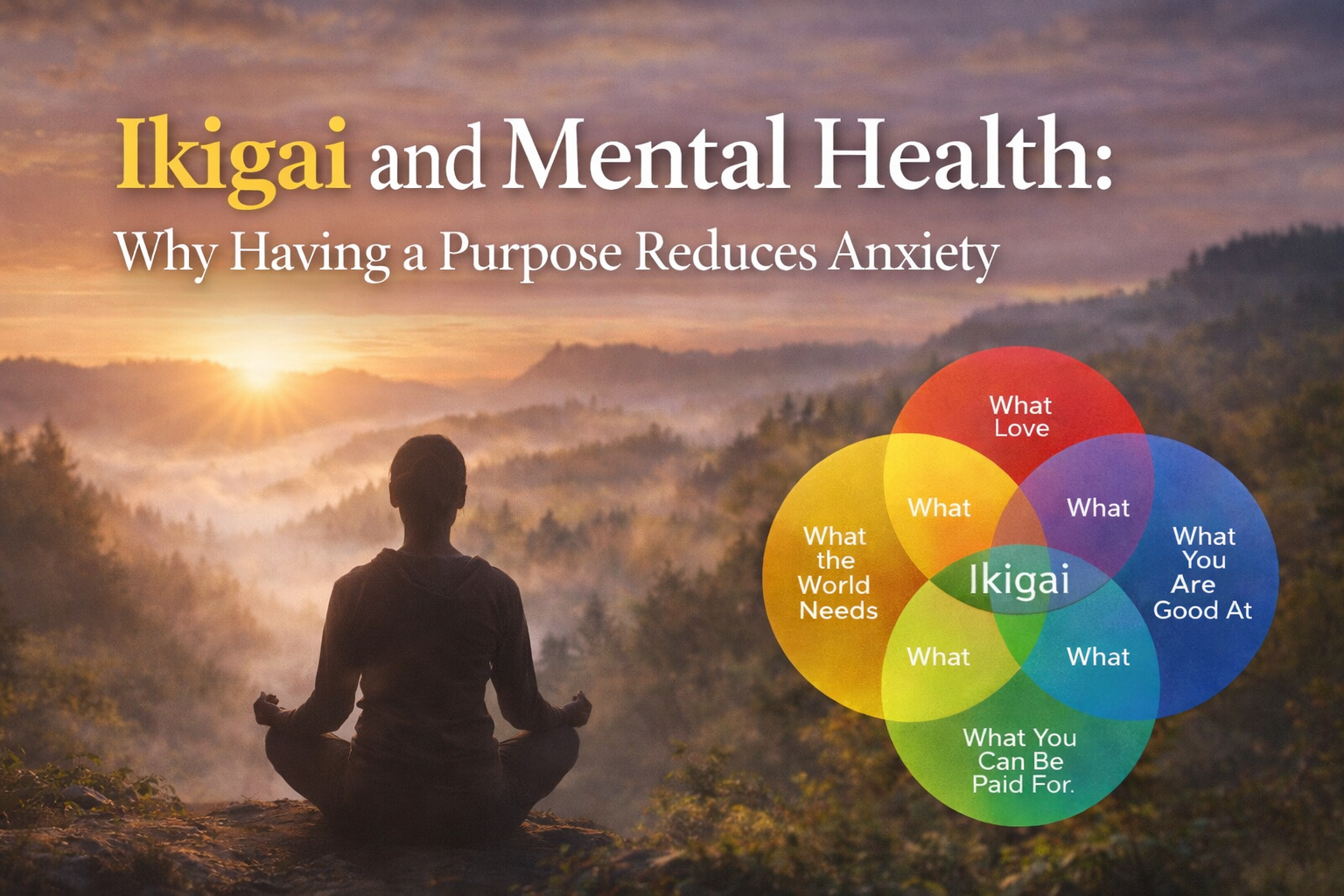
Sit with the four ikigai questions — what you love, what you’re good at, what the world needs, what you can be paid for — and write whatever comes, without judgment. Your first answers don’t need to be right. They need to be honest. Clarity comes through the process of articulating, not before it.
Combine ikigai with professional support — they work beautifully together
Therapists and counsellors often work with questions of identity, values, and purpose — and ikigai gives you powerful material to bring into those conversations. If you’re working with a mental health professional, consider sharing your ikigai reflections with them. The framework can deepen therapeutic work significantly.
What Ikigai Is Not (Important Boundaries)
Before we close, a few important clarifications — because ikigai, like any framework, can be misapplied:
Frequently Asked Questions
Can ikigai help with burnout specifically?
Yes — burnout is often not just exhaustion but a profound disconnection from meaning. When you’re giving everything to work that doesn’t align with your values or use your real strengths, depletion is inevitable. Ikigai addresses burnout at the root by helping you identify what genuinely sustains you — and redirecting your energy accordingly. Many people find that purpose-aligned work is energising even when it’s demanding, rather than draining even when it’s easy.
Is it possible to feel worse before you feel better when exploring ikigai?
Temporarily, yes — and this is normal. Looking honestly at the gap between the life you’re living and the life you want can initially increase discomfort. This is not a reason to stop. It is the discomfort of growing awareness, which is a necessary precursor to meaningful change. If you find the reflection genuinely destabilising, take it slowly and consider doing it alongside a therapist or counsellor.
How quickly can ikigai reduce anxiety?
Small shifts can happen quickly — particularly around contribution and outward attention. Even one meaningful act of helping someone else, or one hour spent on something you genuinely love, can produce measurable mood improvements. Deeper shifts — the sense of having a clear direction and identity — typically build over weeks and months as you consistently engage with the framework and act on what it reveals.
Where’s the best place to start if I want to explore my ikigai?
A guided tool that asks structured questions across all four circles is the most effective starting point. The Ikigai Wizard at ikigaitool.com does exactly this — gently walking you through each dimension and mapping where they overlap. It’s free, takes about five minutes, and requires no account. Many people find it clarifying in ways that hours of unguided reflection didn’t achieve.
The Quietest Revolution in Mental Health
We live in a culture that treats anxiety as a malfunction — something to be managed, suppressed, or medicated away. And sometimes, yes, clinical support is exactly what’s needed. But for millions of people, the anxiety they experience is not a malfunction at all. It is a signal. A signal that something essential is missing from their lives.
That something is purpose. And ikigai is one of the oldest, most human, and most effective frameworks ever developed for finding it.
You don’t need to have it all figured out to begin. You don’t need to be certain. You don’t need to be ready. You just need to be willing to look honestly at what you love, what you’re good at, what the world needs, and what can sustain you — and to take one small step toward the place where those things meet.
That first step is often the most important thing you’ll do for your mental health this year.
“Purpose is not the absence of anxiety. It is the presence of something more compelling than the fear.”
Free · No account needed · 5 minutes
Give your mind
somewhere meaningful to go.
The Ikigai Wizard at ikigaitool.com guides you through your passions, strengths, values, and opportunities — and shows you a clear visual map of where your ikigai lives. The most powerful antidote to anxiety is purpose. Start finding yours today, completely free, no sign-up required.
ikigaitool.com/en/wizard · 100% free · No account required
If you or someone you know is struggling with mental health, please reach out to a qualified professional. In the UK: Mind (mind.org.uk) | In the US: NAMI (nami.org) | International: findahelpline.com