Japanese Philosophy · Purpose · Fulfillment · 5 min read
Somewhere in Japan, there are communities of centenarians who wake up every morning with a quiet sense of joy — not because life is easy, but because they know exactly why they’re getting up. That feeling has a name: Ikigai (生き甲斐). And it might be the most important thing you’ve never thought to find.
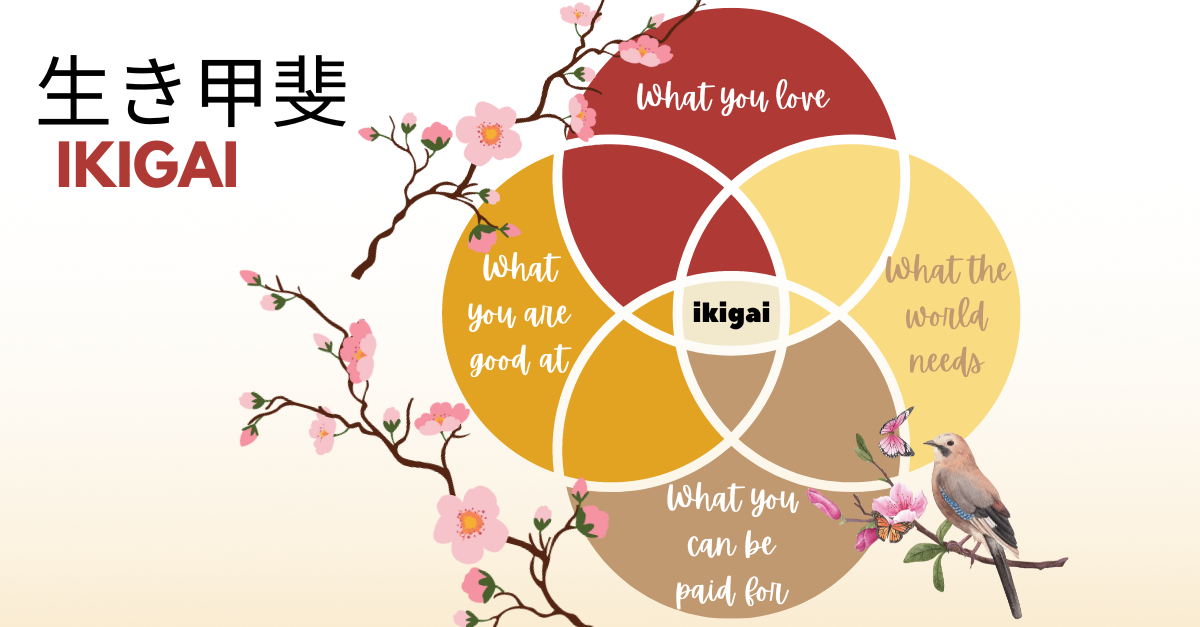
Most of us drift. We fall into careers, routines, and habits — and one day we look up and wonder if this is really what we wanted. Ikigai is the antidote to that drift. It’s a centuries-old Japanese concept that helps you find the intersection of your deepest passions, your greatest strengths, what the world actually needs, and what sustains you financially. When all four overlap? That’s your reason for being.
🌸 What Does “Ikigai” Actually Mean?
The word Ikigai (pronounced ee-key-guy) is made of two Japanese words:
- iki — life
- gai — value, worth, or meaning
Together: “that which makes life worth living.”
The concept is deeply rooted in Okinawan culture — a part of Japan famous for its remarkable number of centenarians. Researchers studying these communities have consistently found one thing in common: a strong, daily sense of purpose. Not grand ambition. Not wealth. Just a clear, personal reason to get up in the morning.
🔵 The Four Circles of Ikigai
The ikigai framework is built around four fundamental questions — each one a circle. Your purpose lives where they all meet.
♥
What you Love
The things that make time disappear. Activities that light you up, even when no one is watching.
✦
What you’re Good At
Your natural talents and hard-won skills. The things people come to you for, often without asking.
◎
What the World Needs
The problems you’re uniquely positioned to solve. Where your gifts create genuine value for others.
◈
What you can Be Paid For
The sustainable, livable expression of your purpose — one that supports you and your life.
The magic happens where all four circles overlap. That center point is your Ikigai.
🔴 The Four Overlap Zones (Where Most People Live)
Where any two circles meet, something meaningful is born. Most people live in one of these four zones — fulfilled in some ways, unfulfilled in others.
| Zone | Circles | What’s missing |
|---|---|---|
| Passion | Love + Good At | Financial sustainability or real-world impact |
| Profession | Good At + Paid For | Joy and personal meaning |
| Vocation | World Needs + Paid For | Personal passion and authentic alignment |
| Mission | Love + World Needs | Financial sustainability to keep going |
Think about where you are right now. Which zone resonates? That awareness alone is valuable — it tells you exactly what to work toward.
⏳ Why Ikigai Matters More Than Ever
We’re living through a quiet crisis of meaning. Despite record productivity, connectivity, and material comfort, burnout and disengagement are at all-time highs. People are busy — but not fulfilled. Successful — but not happy.
Research into Japan’s “Blue Zones” — regions where people routinely live past 100 — consistently points to having a strong sense of purpose as one of the most significant factors in both longevity and wellbeing. The Okinawans don’t have a word for “retirement.” They simply keep living purposefully, whatever form that takes.
“The Japanese don’t retire. They find a reason to wake up every morning — and that reason keeps them alive.”
Viktor Frankl, who survived Auschwitz and wrote about it in Man’s Search for Meaning, documented the same truth: those who had a reason to live endured things that destroyed others. Ikigai is that reason, in everyday form.
✅ How to Start Finding Your Ikigai (Right Now)
You don’t need a weekend retreat or a therapist to start. The ikigai process is deceptively simple — the power is in honest self-reflection, not complexity.
- Write freely, don’t filter. For each of the four circles, list everything that comes to mind. Love baking? Write it. Good at explaining complex ideas simply? Write it. Your first pass should be uncensored and generous.
- Look for repeating threads. What shows up in more than one circle? The items that appear in multiple categories are your most important clues. These are your potential overlaps.
- Find the intersection. What single idea, role, or direction sits at the heart of all four circles? That’s your ikigai. It may surprise you — and it often does.
- Take one small step toward it. Ikigai isn’t a destination you declare — it’s a direction you move in. One meaningful action this week, however small, is worth more than a year of reflection without movement.
💡 The Misconception: Ikigai Isn’t Just a Career Tool
The four-circle diagram is often presented purely as career advice. That’s useful — but it misses the deeper point. In its original Japanese form, ikigai has nothing to do with work at all.
A grandmother who raises her grandchildren with love has ikigai. A gardener who tends to tomatoes each spring has ikigai. A retired teacher who volunteers to mentor students has ikigai. None of these require a salary, a job title, or a five-year plan.
The real insight is this: your reason for being doesn’t have to be heroic, profitable, or impressive to anyone but you. Small, consistent joys are the lifeblood of ikigai — not grand ambitions.
Free · No account needed · Takes 5 minutes
Ready to discover your Ikigai?
We built a free, beautifully simple tool to guide you through the entire ikigai process — step by step, question by question. No sign-up. No fluff. Just clarity.
ikigaitool.com · Completely free · Start in seconds
Found this useful? Share it with someone who’s been asking themselves “what should I do with my life?” — they might find their answer here.