Japanese Philosophy · Self-Discovery · Meaning · 6 min read
“Find your purpose.” You’ve heard it a thousand times — from TED talks, self-help books, career coaches, and motivational Instagram accounts. But here’s what nobody tells you: purpose, as the West defines it, might be making you more anxious, not less. And that’s exactly where ikigai offers something different.
At first glance, ikigai and life purpose seem like the same thing with different packaging. Both are about meaning. Both are about why you get out of bed in the morning. But dig a little deeper and you’ll find they’re rooted in completely different philosophies — with very different effects on how you actually live.
In this post, we’ll break down exactly what separates ikigai from the Western idea of purpose, why that difference matters more than you think, and how understanding both can help you build a life that feels genuinely fulfilling — not just impressive on paper.
What Do We Mean by “Life Purpose”?
In Western culture, “purpose” tends to carry a specific flavor. It’s big. It’s singular. It’s often tied to impact, legacy, or achievement. It sounds like:
- “I was born to build something that changes the world.”
- “My purpose is to leave a legacy.”
- “I need to figure out what I’m meant to do.”
This idea of purpose is heavily influenced by existentialist philosophy, the Protestant work ethic, and — more recently — hustle culture. It places enormous pressure on the individual to identify one grand calling and pursue it relentlessly. The unspoken message: if you haven’t found your purpose yet, something is wrong with you.
And that pressure? Research shows it’s doing real psychological damage. A growing body of studies links the frantic “search for purpose” with higher anxiety, decision paralysis, and a chronic feeling of inadequacy — especially among younger generations.
“The obsession with finding your ‘one true purpose’ may be one of the most anxiety-inducing ideas of modern life.”
What Is Ikigai — Really?
Ikigai (生き甲斐) is a Japanese concept that translates loosely as “that which makes life worth living.” But the nuance matters: in its original cultural form, ikigai is quiet, personal, and plural.
It doesn’t demand that you change the world. It doesn’t require a business plan or a five-year vision. A Japanese grandmother who wakes up each morning to tend her garden has ikigai. A retired teacher who still helps neighbourhood children with their homework has ikigai. A chef who takes pride in feeding people well has ikigai.
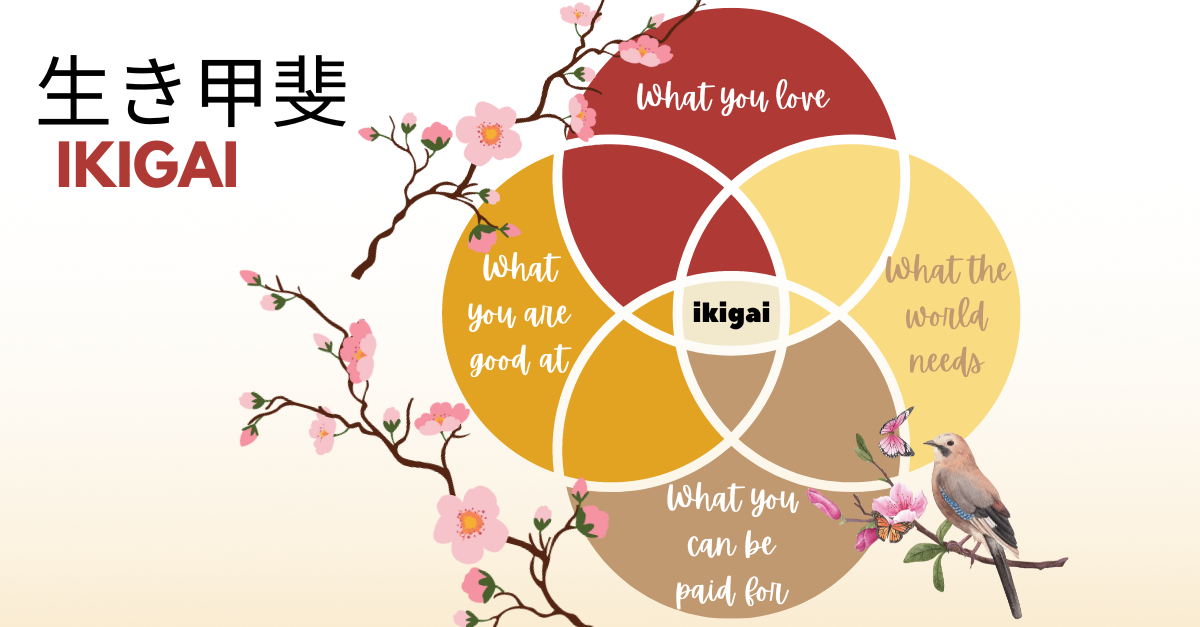
The famous four-circle Venn diagram — what you love, what you’re good at, what the world needs, what you can be paid for — is actually a Western adaptation of the concept, introduced by Marc Winn in 2014. It’s useful, but it’s worth knowing it’s not the traditional Japanese definition.
In Japan, ikigai research by scholars like Ken Mogi and Michiko Kumano describes it as a felt sense of daily engagement and aliveness — not a destination, but a quality of presence in ordinary moments.
Ikigai vs. Purpose: Side-by-Side
Here’s where the two philosophies diverge most clearly:
| Dimension | Western “Purpose” | Japanese Ikigai |
|---|---|---|
| Scale | Grand, world-changing | Small, everyday, personal |
| Number | One singular calling | Many sources of meaning |
| Timeline | Found once, pursued forever | Evolves throughout life |
| Pressure | High — you must find it | Low — it’s already within reach |
| Link to work | Usually career-centric | Can be entirely non-work |
| Feeling when missing | Failure, inadequacy | Gentle invitation to explore |
| Origin | Existentialism, hustle culture | Okinawan daily life, Zen |
Why the Difference Actually Matters
This isn’t just philosophical hair-splitting. The framework you use to think about meaning has direct, practical consequences for your mental health, your career decisions, and your daily experience of life.
1. Purpose thinking creates an arrival fallacy
When you frame meaning as something to be found — a destination you reach — you spend most of your time in a state of not-yet-there. Every job, relationship, or project is evaluated against the question: “Is this my purpose?” Most things inevitably fall short. You’re always in the waiting room of your own life.
Ikigai flips this. Instead of waiting to arrive somewhere meaningful, you cultivate meaning in the present — in your current work, your relationships, your creative habits. The question shifts from “Have I found it yet?” to “What about today feels alive?”
2. Singular purpose is fragile
If your entire sense of meaning rests on one purpose — one career, one mission, one identity — you are extremely vulnerable. Lose the job, face an illness, experience a major life change, and your purpose collapses with it.
Ikigai, by contrast, is distributed across multiple sources of meaning. Your work matters and your relationships matter and your creative expression matters. When one source is disrupted, the others hold you.
3. The pressure to “find your purpose” favours the privileged
Not everyone has the luxury of waiting for a grand calling. For many people, the idea of having one perfect purpose feels tone-deaf — a concept that assumes freedom from financial pressure, family obligations, or systemic barriers.
Ikigai is more democratic. It can be found in the small — in the pride of craft, in the care of others, in the joy of showing up consistently for something you believe in. It doesn’t require the perfect circumstances to take root.
The key insight
Purpose is something you search for. Ikigai is something you notice, nurture, and live. One is a destination. The other is a practice.
Can You Have Both? (Yes — and Here’s How)
Ikigai and purpose aren’t opposites — they can complement each other beautifully. The best approach is to use them at different scales:
Use Ikigai for daily life
Ask: What gives me energy today? What small thing am I proud of? What do I look forward to this week? Ikigai keeps you grounded and alive in the present.
Use Purpose for direction
Ask: What kind of contribution do I want to make over the next decade? What legacy matters to me? Purpose gives you a compass — but ikigai keeps you moving while you use it.
Think of it this way: purpose is the destination on the map; ikigai is the quality of the journey. You need both — one without the other leaves you either wandering or exhausted.
Signs You’re Living With Purpose But No Ikigai
This is more common than you’d think — and it’s worth recognising:
- You’re successful by external standards but feel hollow inside
- You have a clear career mission but dread Monday mornings
- You know what you’re “supposed to” do but rarely feel excited doing it
- You’ve achieved your goals and wonder why you still feel empty
- You’re driven but burnt out — running on discipline, not energy
If this resonates, the answer usually isn’t to find a bigger purpose. It’s to zoom in — to reconnect with the small, daily sources of engagement and joy that give life its texture. That’s ikigai territory.
Signs You Have Ikigai But No Clear Purpose
The opposite pattern is equally real:
- You enjoy daily life but feel directionless long-term
- You have many interests but can’t commit to one path
- You feel happy day-to-day but anxious about the future
- You’re good at many things but unsure what to build toward
- You live in the moment beautifully but struggle with big decisions
Here, ikigai gives you an excellent foundation — but you may benefit from zooming out and asking the bigger directional questions that purpose thinking offers.
Common Questions
Is ikigai a replacement for therapy or career coaching?
No — ikigai is a reflective framework, not a clinical tool. For deep issues around identity, mental health, or major life transitions, professional support is invaluable. Ikigai works beautifully alongside therapy or coaching as a self-reflection practice.
Can my ikigai change over time?
Absolutely — and it should. Ikigai is not a tattoo. As you grow, your values shift, your skills deepen, and your circumstances change. Revisiting your ikigai every year or two is healthy and often revealing.
Do I need to choose between ikigai and purpose?
Not at all. The most fulfilled people tend to operate with both — ikigai grounds them in the present, while a sense of broader purpose orients them toward the future. Use each where it serves you best.
The Bottom Line
The Western pursuit of purpose is powerful — but it often asks too much, demands it all at once, and makes us feel like failures when life doesn’t deliver a clear answer fast enough.
Ikigai offers a gentler, more sustainable path. It doesn’t ask you to be extraordinary. It asks you to be present — to notice what energizes you, honor what you’re good at, show up for what the world needs from you, and find a way to sustain it.
You don’t have to choose one or the other. But if you’ve been burning yourself out chasing a grand purpose and still feeling empty, it might be time to try starting smaller. Start with today. Start with what’s already in front of you. Start with ikigai.
Free · No account needed · Takes 5 minutes
Not sure where your ikigai lives?
Let’s find it together.
The Ikigai Wizard at ikigaitool.com walks you through thoughtful guided questions about your passions, strengths, values, and goals — and shows you exactly where they overlap. No sign-up. No fluff. Just clarity.
Discover My Ikigai — It’s Free →
ikigaitool.com/en/wizard · 100% free · No account required
Know someone caught in the endless “find your purpose” loop? Share this with them — it might change how they think about meaning entirely.