Purpose · Japanese Philosophy · Self-Discovery · 6 min read
Have you ever felt like you’re working hard, but something is still missing? Like you’re busy — but not really alive? You’re not alone. And there’s an ancient Japanese concept that might hold the answer: Ikigai.
Ikigai (pronounced ee-key-guy) is the Japanese philosophy of finding your “reason for being.” It’s the sweet spot where what you love, what you’re good at, what the world needs, and what you can earn from all come together. And the best part? You don’t need to quit your job or move to Okinawa to find it.
In this guide, we’ll walk you through exactly how to find your ikigai in 5 clear, actionable steps — plus a free tool that makes the whole process effortless.
Why Finding Your Ikigai Changes Everything
Research into Japan’s Blue Zones — regions where people regularly live past 100 — points to one consistent factor: a strong daily sense of purpose. The people of Okinawa don’t have a word for “retirement.” They simply keep living with intention.
Studies in positive psychology back this up too. People who report a clear sense of purpose experience:
- Lower levels of stress and anxiety
- Better sleep and physical health
- Higher career satisfaction and performance
- Stronger relationships and sense of belonging
- Longer life expectancy
Ikigai isn’t a luxury — it’s a fundamental human need. And finding yours is more achievable than you think.
✨ Skip the guesswork
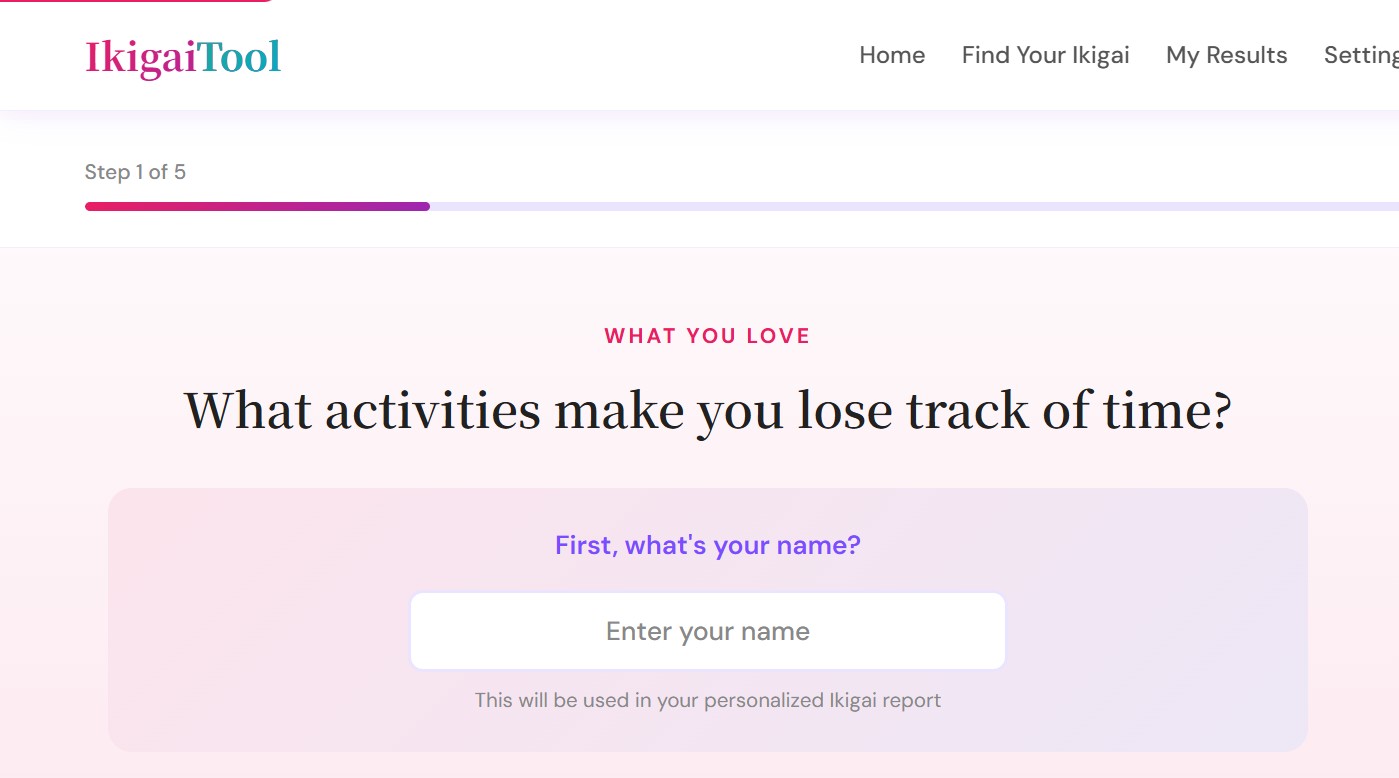
Try the free Ikigai Wizard
Answer a few guided questions and get your personal ikigai map — free, no account needed.
The Ikigai Framework: 4 Questions That Reveal Your Purpose
Before diving into the steps, it helps to understand the model. Ikigai sits at the center of four overlapping circles, each representing one core question:
① What do you LOVE?
Activities that energize you, bring joy, and make time fly.
② What are you GOOD AT?
Your natural talents, learned skills, and areas of deep expertise.
③ What does the world NEED?
Real problems you can help solve. Value you can create for others.
④ What can you be PAID FOR?
Skills and contributions that are financially sustainable.
Your ikigai lives where all four overlap. Now let’s find yours.
How to Find Your Ikigai: 5 Simple Steps
List Everything You Love (Without Filtering)
Grab a notebook or open a blank doc. Write down everything you love doing — no matter how small, strange, or “impractical” it seems. Love explaining things? Write it. Obsessed with cooking? Write it. Can’t stop drawing? Write it.
The rule here is zero judgment. This is not a resume — it’s a brainstorm. Include hobbies, childhood passions, anything that puts you in a state of flow.
💡 Try asking yourself: What would I do even if no one paid me? What do I lose track of time doing? What topics do I read about for fun?
Identify What You’re Genuinely Good At
This is harder than it sounds — we often undervalue our own skills. Write down everything you’re naturally talented at or have worked hard to develop. Include both hard skills (coding, writing, design) and soft skills (empathy, leadership, problem-solving).
Then ask two or three people who know you well: “What do you think I’m really good at?” You’ll be surprised what others see that you take for granted.
💡 Try asking yourself: What do people ask me for help with? What comes easily to me that seems hard for others? What have I spent 100+ hours practicing?
Discover What the World Needs from You
This circle is about contribution. Think about the problems around you — in your community, your industry, your relationships — that you could help solve. It doesn’t have to be world-changing. It just has to be genuinely useful.
The best ikigai answers this circle with something that intersects with your love and your skills. That’s where meaning explodes.
💡 Try asking yourself: What problems do I see that frustrate me? Who do I most want to help? What change do I want to see in my field or community?
Explore What You Can Be Paid For
This is the reality-check circle — and it’s an important one. Purpose without sustainability burns out. Think honestly about which of your skills and contributions people would actually pay for, whether through a job, freelancing, a business, or even a side project.
Note: This doesn’t mean you need to monetize your passion directly. It means finding an expression of your purpose that can support your life.
💡 Try asking yourself: What would someone hire me to do? What skills do employers or clients consistently value? Is there a market for what I love doing?
Find the Overlap — and Take One Step Toward It
Now look at your four lists side by side. What appears in more than one? What single theme, role, or direction sits at the heart of all four circles? That intersection — however surprising — is your ikigai.
Once you spot it, don’t just contemplate it — act on it. Take one small, concrete step this week. Sign up for a course. Start a project. Have a conversation. Ikigai isn’t a destination you arrive at; it’s a direction you move in.
💡 Still not sure where your four circles overlap? The Ikigai Wizard at ikigaitool.com guides you through this exact process with thoughtful questions and visualizes your results for free.
3 Common Mistakes People Make When Searching for Their Ikigai
Avoid these traps — they’re the reason most people give up before they find anything meaningful:
Frequently Asked Questions About Ikigai
How long does it take to find your ikigai?
There’s no fixed timeline. Some people feel a strong pull after one focused session of reflection. For others, clarity emerges over weeks or months of small experiments. The important thing is to start — even an hour of honest self-reflection using a structured tool can open doors you didn’t know existed.
Can I have more than one ikigai?
Yes — and in fact, ikigai in its original Japanese meaning is often plural. You can find meaning in your work, your relationships, your creative pursuits, and your community, all at once. The framework helps you identify the strongest threads, but it doesn’t limit you to one answer.
What if I don’t know what I’m passionate about?
This is incredibly common — especially if you’ve spent years doing what you “should” do rather than what excites you. The answer isn’t to think harder; it’s to try more things. Use the reflection prompts in this guide, talk to people who know you well, and try a guided tool like the Ikigai Wizard to help surface patterns you might be overlooking.
Is ikigai the same as finding your life purpose?
It’s related but subtler. Western ideas of “life purpose” often imply one grand calling. Ikigai is more grounded — it’s about the everyday reasons that make life feel worth living. It can be as simple as the joy of cooking for your family, or as ambitious as building a company that solves a global problem. Both count.
Free · No account needed · 5 minutes
Stop searching. Start discovering.
The Ikigai Wizard guides you through thoughtful questions about your passions, skills, values, and goals — and visualizes exactly where they overlap. Free. No sign-up required.
ikigaitool.com/en/wizard · Completely free · Start in seconds
Know someone stuck at a career crossroads or searching for more meaning in life? Share this post — it might be exactly what they need to read today.